

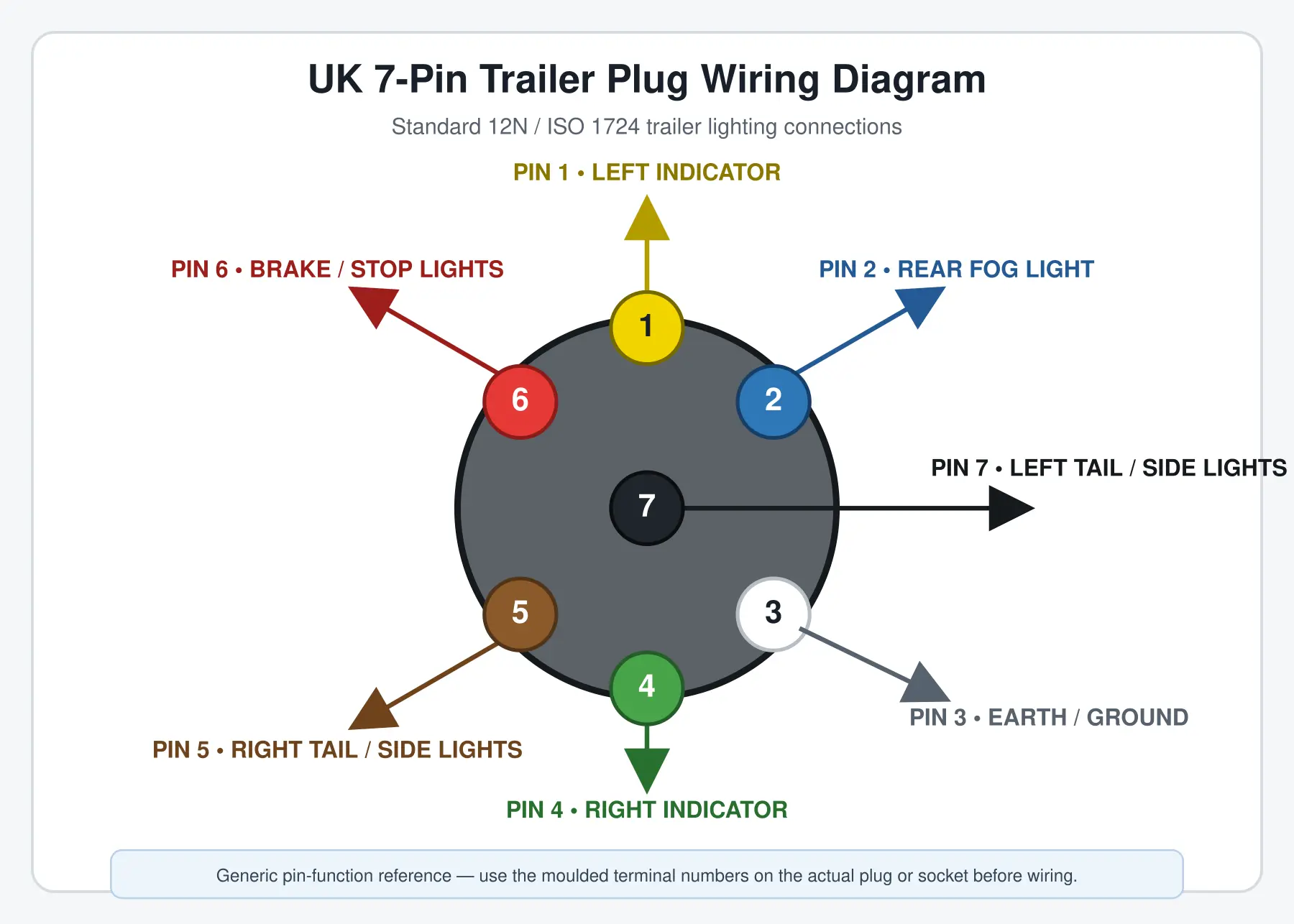
7 pin trailer wiring diagrams can help you identify which wire controls each trailer lighting function and diagnose common faults. This guide explains the standard UK 12N wiring layout, including indicators, tail lights, brake lights, fog lights and the earth connection. We also explain the difference between 7-pin and 13-pin trailer plugs, and when a damaged plug or wiring fault should be checked by a professional.
What Is a 7-Pin Trailer Wiring Diagram?
A 7-pin trailer wiring diagram shows how the electrical connections in a standard UK trailer plug are assigned. The UK 7-pin connector is commonly known as a 12N plug and is used for the trailer’s basic road lighting.
It connects the towing vehicle to the trailer’s:
- Indicators
- Tail and side lights
- Brake lights
- Rear fog light
- Number plate lights
- Earth connection
The standard 7-pin 12N connector does not provide a connection for reversing lights or additional power supplies. These functions are normally associated with a 13-pin trailer plug.
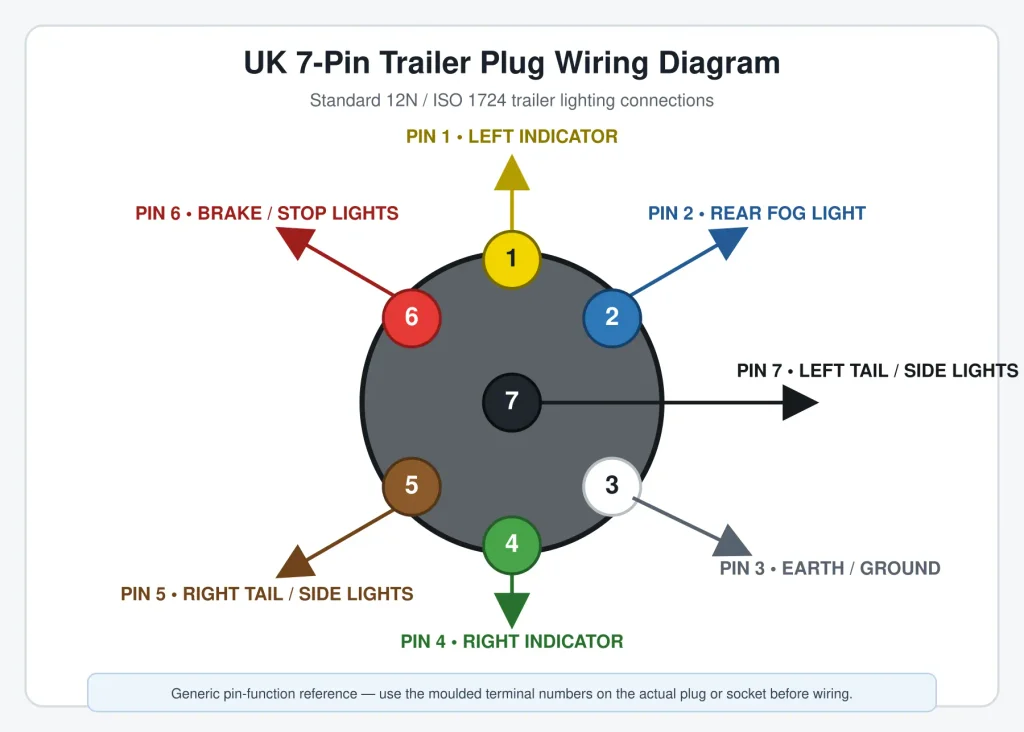
UK 7-Pin Trailer Wiring Diagram and Pin Functions
The standard wiring arrangement is:
| Pin | Wire colour | Function |
|---|---|---|
| 1 | Yellow | Left-hand indicator |
| 2 | Blue | Rear fog light |
| 3 | White | Earth connection |
| 4 | Green | Right-hand indicator |
| 5 | Brown | Right-hand tail and side lights |
| 6 | Red | Brake or stop lights |
| 7 | Black | Left-hand tail and side lights |
The wire colours shown are the standard UK arrangement, but wiring should always be checked against the markings on the plug, the trailer’s wiring diagram or a suitable testing device. Older trailers or trailers that have been repaired may not follow the original colour coding.
When viewing a wiring diagram, check whether it shows the rear of the plug, the front of the socket or the terminal side. Looking at the wrong side can make the pin positions appear reversed.
What Does Each 7-Pin Trailer Connection Do?
Pin 1 – left indicator
The yellow wire carries the signal for the trailer’s left-hand indicator.
If the left indicator is not working but the right indicator is functioning, the fault may be with the lamp, wire, plug terminal or pin 1 connection.
Pin 2 – rear fog light
The blue wire supplies the trailer’s rear fog light.
A standard 7-pin 12N trailer plug does not include a reversing-light connection.
Pin 3 – earth
The white wire provides the earth return for the lighting circuits. A reliable earth connection is essential for the trailer lights to work correctly.
A poor earth can cause lights to become dim, flicker or behave strangely. For example, the indicators may flash through another lighting circuit when the brake pedal is pressed.
Pin 4 – right indicator
The green wire carries the signal for the trailer’s right-hand indicator.
A fault affecting only the right indicator may be linked to the lamp, wiring or pin 4 connection.
Pin 5 – right-hand tail and side lights
The brown wire supplies the trailer’s right-hand tail and side lights. It may also supply the right-hand number plate light, depending on the trailer’s wiring arrangement.
Pin 6 – brake lights
The red wire carries the brake-light signal from the towing vehicle to the trailer.
Both trailer brake lights should illuminate when the vehicle’s brake pedal is pressed.
Pin 7 – left-hand tail and side lights
The black wire supplies the trailer’s left-hand tail and side lights. It may also supply the left-hand number plate light, depending on the trailer’s wiring arrangement.
Common Trailer Lighting Faults
Trailer lighting faults are often caused by a problem with the plug, socket, earth connection or wiring rather than the light itself.
Common causes include:
- Corrosion inside the plug or socket
- Dirt or water affecting the electrical contacts
- A loose wire inside the plug
- Bent, broken or worn pins
- A damaged cable near the plug
- Chafed wiring underneath the trailer
- A poor earth connection
- A blown fuse on the towing vehicle
- A failed bulb or LED lamp unit
- An incorrectly wired replacement plug
- A fault with the vehicle’s towbar wiring module
- LED lights that are not compatible with the vehicle’s electrics
The National Trailer and Towing Association provides industry guidance and support for trailer owners and businesses. Sleaford Trailers is an NTTA Trusted Workshop, providing trailer servicing and repair work from its workshop near Sleaford.
Why Are My Trailer Indicators Not Working?
If one trailer indicator is not working, check the relevant lamp, connector, wire and plug terminal. A fault affecting one side may be local to that circuit.
If both indicators are not working, the problem could be related to:
- The earth connection
- The vehicle’s towing fuse
- The towbar socket
- The trailer plug
- The vehicle’s towbar control module
- A damaged section of wiring
The connector should be inspected before replacing bulbs or rewiring the trailer.
Why Are My Trailer Brake Lights Not Working?
Trailer brake lights may stop working because of:
- A failed bulb or LED lamp unit
- A loose connection at pin 6
- Corrosion inside the plug or socket
- Damaged wiring
- A blown fuse
- A fault with the towbar wiring or control module
If the vehicle’s own brake lights are working but the trailer brake lights are not, the fault is likely to be somewhere between the vehicle socket and the trailer lamps.
Why Are My Trailer Side Lights Not Working?
If one side light is not working, check the corresponding tail-light circuit, lamp and wiring.
If both side lights have failed, possible causes include:
- A poor earth connection
- A fault with the towing vehicle
- A damaged plug or socket
- Problems with pins 5 or 7
- A blown fuse
- A break in the main trailer cable
Dim or flickering side lights are often associated with corrosion, loose connections or a poor earth.
7-Pin Versus 13-Pin Trailer Plugs
A 7-pin 12N plug is generally used for a trailer’s basic lighting. A 13-pin plug provides the same core lighting functions but also has additional connections for reversing lights and power supplies.
| Function | 7-pin 12N | 13-pin |
|---|---|---|
| Left indicator | Pin 1 | Pin 1 |
| Rear fog light | Pin 2 | Pin 2 |
| Lighting earth | Pin 3 | Pin 3 |
| Right indicator | Pin 4 | Pin 4 |
| Right tail lights | Pin 5 | Pin 5 |
| Brake lights | Pin 6 | Pin 6 |
| Left tail lights | Pin 7 | Pin 7 |
| Reversing light | Not available | Pin 8 |
| Permanent 12V supply | Not available | Pin 9 |
| Ignition-switched supply | Not available | Pin 10 |
A 13-pin trailer plug is often used for caravans and newer trailer applications because it can carry additional electrical functions through one connector.
An adaptor can allow a vehicle with a 13-pin socket to connect to a trailer with a 7-pin plug. However, the adaptor cannot create functions that are not available through the original 7-pin wiring. For example, reversing lights and auxiliary power will not work through a basic 7-pin connection.
If you need a replacement plug, socket or adaptor, visit Sleaford Trailers’ trailer parts and spares page
When Should a Trailer Plug Be Replaced?
A trailer plug may need replacing if it has:
- Cracked or melted plastic
- Heavily corroded pins
- Broken or loose terminals
- Bent pins that no longer make reliable contact
- Water damage
- Damaged cable where it enters the plug
- Wires that will not clamp securely
- An intermittent fault that returns after cleaning and tightening
A replacement plug must be wired to the correct pin numbers and tested afterwards. All indicators, tail lights, brake lights, fog lights and hazard lights should be checked before the trailer is used on the road.
When Should You Seek Professional Help?
You should arrange a professional inspection if:
- Several trailer lights have failed at once
- A replacement fuse blows immediately
- There is visible melting or burning
- The wiring loom is damaged
- The fault keeps returning
- LED lights are causing warning messages
- You are unsure which wiring standard the trailer uses
- The fault affects the brake lights
- Cleaning the plug and checking the connections has not solved the problem
Trailer lighting is safety-critical. Do not tow the trailer on the road until all legally required lights are working correctly.
Sleaford Trailers can help with trailer repairs and trailer servicing, including checks of trailer lights and electrical connections.
How Can I Prevent Trailer Wiring Problems?
A few simple checks can reduce the risk of trailer lighting faults:
- Inspect the plug and socket before towing
- Keep connectors clean and protected when not in use
- Look for cracked plugs, loose pins or damaged cable
- Check the earth connection
- Secure wiring underneath the trailer so it cannot drag on the road
- Test every light before setting off
- Avoid using a trailer with intermittent lighting faults
- Arrange servicing if the trailer is used regularly or stored for long periods
Sleaford Trailers also provides trailer hire across Lincolnshire. Customers hiring a trailer should ensure that their vehicle has working towing electrics and the correct plug or adaptor before collection.
Need Advice?
If you’re unsure which trailer is suitable for your load or would like your trailer checked before a long journey, our experienced team is happy to help.
We regularly assist customers from Sleaford, Lincoln, Grantham, Boston, Newark and Spalding.
Call 01529 462188 for advice.
7-Pin Trailer Wiring: FAQs
What is a 7-pin trailer plug used for?
A standard UK 7-pin 12N trailer plug connects the towing vehicle to the trailer’s indicators, tail lights, brake lights, rear fog light and earth connection.
What colour wire is the earth on a 7-pin trailer plug?
The standard earth wire is white and connects to pin 3. However, wiring should always be checked against the markings on the plug because repairs or non-standard wiring may affect the colours.
Which pin is the brake light on a 7-pin trailer plug?
The brake-light connection is pin 6, which normally uses a red wire.
Which pin is the fog light on a 7-pin trailer plug?
The rear fog-light connection is pin 2, which normally uses a blue wire.
Can a 7-pin trailer plug operate reversing lights?
No. A standard 7-pin 12N plug does not provide a reversing-light connection. Reversing lights generally require a 13-pin trailer plug or another suitable wiring arrangement.
Can I connect a 7-pin trailer to a 13-pin socket?
Yes. A suitable 13-pin to 7-pin adaptor can connect the basic lighting circuits. Additional functions such as reversing lights or auxiliary power will not work through the 7-pin connection.
Why do my trailer lights flicker?
Flickering trailer lights may be caused by a poor earth, corrosion, loose plug connection, damaged wiring or a faulty lamp unit. The plug, socket and earth connection should be checked before the trailer is used.
Can I replace a 7-pin trailer plug myself?
A competent person may be able to replace a standard 7-pin plug, but the wiring must be connected to the correct pin numbers and tested thoroughly afterwards. If the wiring is damaged, unusual or difficult to identify, professional help is safer.
Does Sleaford Trailers repair trailer wiring?
Sleaford Trailers carries out trailer repairs and servicing, including checks of trailer lights and electrical connections. Contact the workshop to discuss the fault and arrange an inspection.
Contact Sleaford Trailers to discuss a trailer wiring problem, replacement plug or electrical fault.
Sleaford Trailers | Trailer Servicing | Trailer Repairs | Trailer Hire | Trailer Sales | Lincolnshire White House Farm, Ewerby Thorpe, Sleaford, NG34 9PR Tel: 01529 462188 | sales@sleafordtrailers.co.uk